
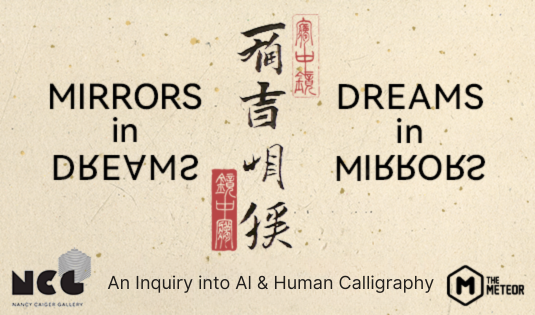
Dreams in Mirrors, Mirrors in Dreams
An exhibition by Zixuan Gong
When artificial intelligence enters artistic creation, is it ultimately a mirror that reflects reality, or a dreamscape unbound by reality?
This exhibition presents 17 calligraphic works, of which five are AI-generated pseudo-characters and twelve are hand-copied by the artist. In the creative process, the artist does not compel the AI to act as a mirror, demanding an objectively accurate mapping of reality. Instead, the AI is permitted to “think” through its own inherent operational logic. Based on the structure of Chinese characters in the training dataset, AI imagines form that conform to calligraphic aesthetics yet carry no real-world semantics—they are as unbridled as dreams, yet like reflections in a mirror, they map the statistical probabilities of the dataset.
In the gallery, the AI works are displayed on fixed perimeter walls, while the hand-written pieces stand on mobile partitions in the center, creating a face-to-face dialogue. As viewers move between them, they find themselves caught in a constant state of comparison, hesitation, and judgment between readable and unrecognizable generations. For audiences unfamiliar with Chinese characters, this difficulty of discernment is amplified: both genuine and pseudo-scripts are stripped of their linguistic function, reduced to pure visual symbols. What remains is a primal play of ink, rhythm, and space.
This exhibition does not seek to answer whether AI can replace the artist. Instead, it serves as a site of inquiry. When machines can mimic brushstrokes, structure, and even Qi, where does human creative agency truly reside? At the intersection of the mirror and the dream, perhaps we can truly begin to contemplate—that which is fundamentally human, and must never be ceded.
Zixuan Gong is a visual artist whose practice bridges the realms of imagery and algorithms. He is currently a PhD candidate in Screen and Media Studies at the University of Waikato.
Over the past two decades, Gong has dedicated his work to light and shadow as a narrative language, traversing the boundaries between cinematography and contemporary art. Collaborative works to which he has contributed as a key creative have been showcased at prestigious international festivals, and art institutions.
In recent years, his creative research has pivoted toward generative artificial intelligence, interrogating the dual metaphor of the algorithm as both Mirror and Dream—a mechanism that reflects collective human experience while simultaneously transcending the logic of reality through autonomous generation.
Please join us at the opening event for Dreams in Mirrors, Mirrors in Dreams on Saturday 30th May, 12pm.
The Nancy Caiger Gallery is open 11am-2pm from Wednesday to Saturday. If you’d like to visit this exhibition outside of these opening hours, please email [email protected]